SupraKuda MATS Projects 2009

Home
Club Info
Projects
Newbie
Calendar
Interclub TD Series
SupraKuda

First fuselage
18 April 2010

The first fuse has been taken out of the mould. A wise combination of glass, kevlar and carbon fiber cloth for a 2.4GHz friendly fuselage.
Some minor defects over the pylon area but already a very good weight to stiffness ratio. As a matter of fact the weight is equal to the original Supra but our design is a little larger...I don't know how Steve can squeeze so much resin out of the layup, kudos to him!!!
 

MATS SupraKuda MATS Projects 2009


Wooden ribs, servo mounting plates & CO
31 March 2010

The appetite comes by eating
...the laser cut machine works perfectly therefore we have generated the .dxf files and cut the rest of the components. All the ribs and the servo mounts have then been assembled. Sweet!!!
 

MATS SupraKuda MATS Projects 2009 
SupraKuda MATS Projects 2009


Wing Central Panel Spar
23 March 2010

Flanges have been realized curing strips of pre-cured 0.007" thick carbon UD. Webs are balsa made. Jacques has found a source for laser cutting wooden parts: balsa planks have been scribelined so that cutting is now a piece of cake.

 
SupraKuda MATS Projects 2009 SupraKuda MATS Projects 2009 SupraKuda MATS Projects 2009

SupraKuda MATS Projects 2009 SupraKuda MATS Projects 2009

Webs and flanges have been then epoxied together with the wing joiners.

SupraKuda MATS Projects 2009 SupraKuda MATS Projects 2009

The central portion of the spar has been wrapped and a carbon sox has been put over the whole thing.

SupraKuda MATS Projects 2009 SupraKuda MATS Projects 2009 SupraKuda MATS Projects 2009

The spar comes out of the bag at the weight of 290gr.

SupraKuda MATS Projects 2009


Fuselage Master & Mould
19 March 2010

The plug for the mould is wooden made, painted and polished by Stephen. The mould is split for de-moulding, because of the geometry of the pylon. The surface is shiny and flawless and the mould is really robust...no distortion whatsoever with such a brick!
 

SupraKuda MATS Projects 2009 SupraKuda MATS Projects 2009

SupraKuda MATS Projects 2009 SupraKuda MATS Projects 2009 SupraKuda MATS Projects 2009


V-Mount
24 Jan 2010

Jacques has put together a mould for the V-Mount and produced a series of V-Mount based on his experience with the Allegro V-Mount
. Once again very nice job!
 

MATS SupraKuda MATS Projects 2009
SupraKuda MATS Projects 2009


HStab test
23 Jan 2010

The H-Stab has been redesigned following a catastrophic failure at the first load test. A new configuration for the Spar has been found and tested. We now have a carbon tube as a spar and the test shows compliance with more than 20lb applied in the middle section. Some HStabs have been already built with glass skins.
New HStabs will probably have Kevlar skins.


SupraKuda MATS Projects 2009 SupraKuda MATS Projects 2009


The idea...
5 Jan 2010

The Project started very smoothly. After flying many TD competitions, a lot of pilots was discussing about how these new very light and very beautiful moulded models have changed completely the way we Thermal Fly nowadays.

Nevertheless, these new machines are somewhat fragile, often expensive, and, especially if you live so far from the manufacturers in the New World, very difficult to obtain.

Well, let's put it this way: if you then put together the craftmanship of Steve Barry, the energy and managerial push of Jacques Girard, the incredible and never ending source of information from all over the world namely Duc LeVan, and the design skills of your very Italian Luca, you basically kick-off a brand new, Supra inspired project for a big big model.

The project has been presented to the MATS AGM 2009 and we hope new enthusiasts will join the team soon to build more gliders with us!

So, here's the design goals:
1. The model has to be big (minimum wingspan 3.8m, the bigger the better!)
2. The model has to be strong (Luca's zooms wanted!)
3. Aerodynamic design must be first of all reliable (fly by yourself Baby!)
4. The model has to be easy to be manucfactured (bagged wings, no expensive building techniques!)
5. Who said extra light? (if you need ballast all the time, put that weight into the structure!)
6. The Fuselage, H stab and Central Wing Panel should be common between "short" and "long" version (Keep It Simple!)

Wing design

The benchmark is certainly the Supra. A first wing planform has been sketched and Reynolds numbers have been calculated based on a weight target (i.e. 2Kg-2.5Kg), way higher than the Supra (1.4Kg-1.8Kg). By istance at the root section the Sq(Re) range is 110K-130K versus 98K-110K of the Supra.

One can have a look at the final configuration of the 3.8m and 4.0m hereby:

SupraKuda MATS Projects 2009

The root section of the Supra is scarily thin being 8% thick only. A thicker section would give higher bending stiffness properties, reducing tip deflection, but with which aerodynamic penalty?

XFoil has been used to check if a thickened Ag40 would be the airofil of choice. As shown in the picture hereunder, a thicker airfoil shows better performances at mid to high Cl,while the thinner section seems being less draggy at the low Cl. A quick estimation of a full wing (induced drag approximated using Cl2/(Pi * AR) being AR = 20) has been performed too, showing that eventually the penalty is very reduced. The curves are so close that we can even claim we have a little advantage against the original section (after all "you believe in what you want to believe"...isn't it? :-D). It is no surprie really, thicker airfoils are more tailored for higher Re!

SupraKuda MATS Projects 2009

Similar studies have been performed leading to the conclusion that the weight increase basically shifts outboards the optimal airfoil for each section of the Supra wing. Therefore the airfoils of the SupraKuda are Ag40d-9 (being the AG40d thickened to 8%), AG40d, Ag41d and Ag42d (the last three being kept at the original thickness).

You can find the templates for those sections hereunder:

AG40d-9%
AG40d
AG41d
AG42d

H Stab

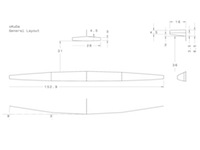
In order to use the same stabiliser for both 3.8m and 4.0m wings, a compromise has to be found. A generous Tail Volume (i.e. 0.4) has been targeted for the 3.8m version giving for the bigger version a Tail Volume of 0.37. The same Lh = 37in (i.e. distance between the 25% of the MAC of the wing and the stabiliser) is used so that the same fuselage can be flown with both wings.The final configuration for the H stab is the following.

H Stab Planform

The airfoil chosen for the H Stab is a 8% thickened version of the HT14. The thicker section is far easier to build than the original airfoil. Being thicker is also stiffer in terms of bending and torsion. We basically traded some aerodynamic advantage for ease of build and robustness. Here's the results:

H Stab Airfoils Templates


Last update 25 April 2010
Contact the webmaster